
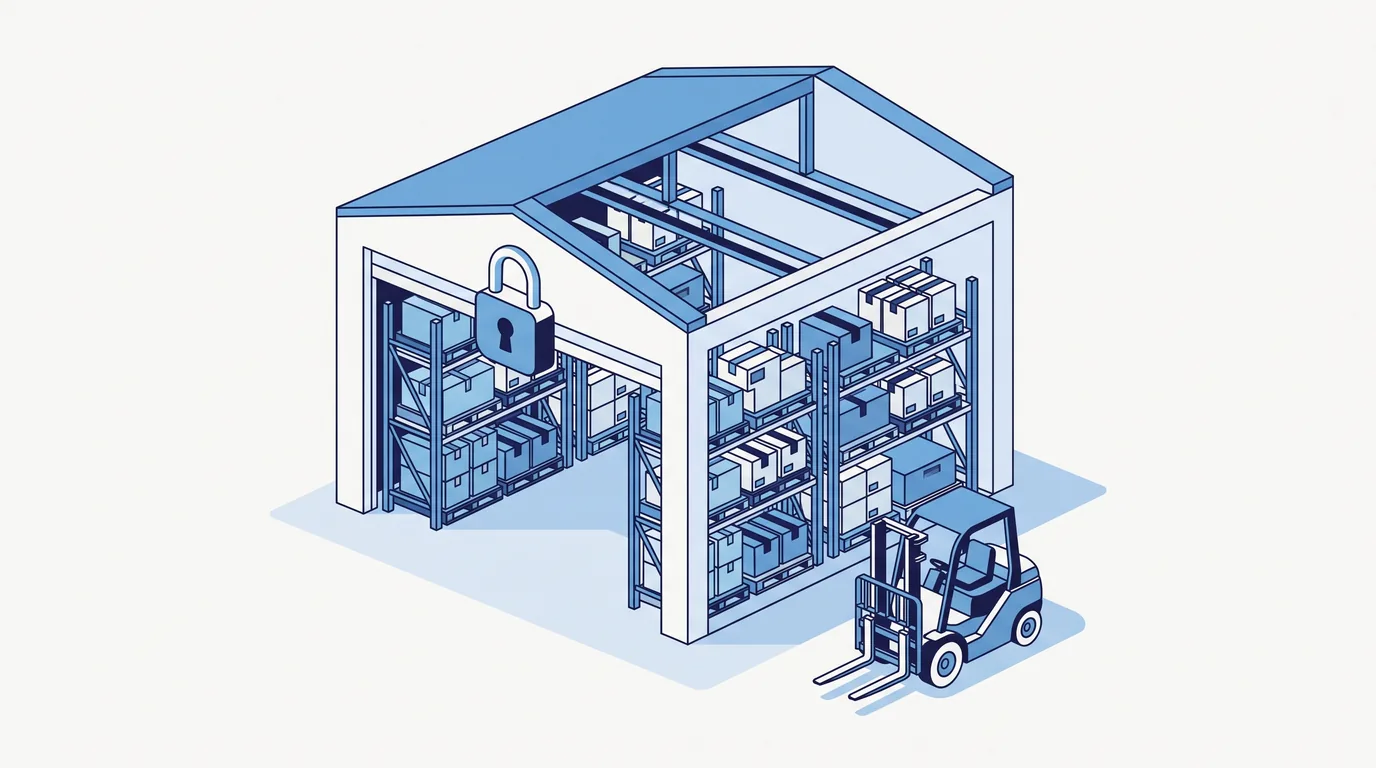
A bonded warehouse (formally "depósito fiscal" under Mexican Customs Law) is an authorized facility where you can bring imported goods into national territory without immediately paying the general import duty (IGI) or VAT.
The tax deferral applies while the goods remain in the warehouse. Taxes are paid at the moment the goods leave the warehouse for the domestic market.
How it works in practice
The process has three stages:
1. Entry into the warehouse: your customs broker files a bonded warehouse pedimento (a Mexican customs entry, code A4). The goods clear the border without import taxes and remain in the warehouse's custody.
2. Storage: the goods can stay in the warehouse indefinitely (the general bonded regime has no maximum term). During that time you can move, consolidate or split them inside the facility, but nothing leaves without regularizing the entry.
3. Withdrawal: when you decide to release goods into the Mexican market, a withdrawal pedimento is filed and taxes are paid at the exchange rate and duty rate in force at that moment.
The three reasons it pays off
Cash flow: you pay taxes when you sell, not when you receive. For importers with long inventory cycles (furniture, machinery, seasonal inputs), that can free up significant working capital.
Just-in-time distribution: large retailers and manufacturers use bonded storage as a buffer. They import full containers (FCL) to capture freight economics, then withdraw goods in small lots as needed, paying VAT only on what actually enters their operation each week.
Re-export at no tax cost: if part of the goods will be re-exported (defects, surplus, order changes), you can do it without ever having paid import taxes. Highly relevant for maquiladoras and triangulated operations.
When it does not pay off
The structure only adds cost if your inventory turns very fast and margins are thin, so that the storage fee charged by the authorized warehouse outweighs the financial benefit of the deferral. Run the math: your cost of capital versus the monthly rate per square meter.
Also consider that bonded operations demand more document management. Every movement of goods generates entries and accounting reconciliations. If your team cannot sustain that control, the benefit evaporates in operating errors.
Logwell can run the cost-benefit analysis for your specific operation and, if the numbers work, manage the full setup: selecting the authorized warehouse, parameterizing your ERP and training your trade compliance team.
Sources and references
- Mexican Customs Law, Articles 119-123 (bonded warehousing)
- SAT, Guide to Authorized General Deposit Warehouses
About the author
Logwell Team
Warehousing Practice
Logwell's warehousing practice operates its own bonded facilities in Nuevo Laredo and Mexico City, managing bonded inventory for importers in manufacturing, retail and pharma.
Still have a question?
Need a freight quote?
Tell us the origin, destination and cargo type. We cover ground, air and ocean with a reply in under 2 hours.
Request a quoteShare